
People need a tolerance for uncertainty
Article published by the German Strive Magazine, Issue 6 of 2025, p.30:
"Dossier: Positive Mindset - Staying confident in uncertain times: a challenge for many people right now. A search for clues with a very positive outcome."
The interviewee: Dr Judith Mangelsdorf is a psychologist and professor of positive psychology at the German University for Health and Sports. (LinkedIn) Here she explains how we can stay positive in difficult times.
Summary & Translation by Julia Hager, psychologist BSc. and German state-approved translator
LinkedIn post with the article's announcement by Dr Mangelsdorf (German)
As we approach New Year’s Eve, it is natural to feel a bit of "future-anxiety." To help navigate these feelings, here is a summary of insights from Dr. Judith Mangelsdorf, a Professor of Positive Psychology, along with practical tips to help you stay resilient and hopeful for the year ahead.
-
Why Everything Feels So "Bad" Right Now
If you feel like the world is in a constant state of crisis, you aren't alone. But there is a biological reason for this feeling.
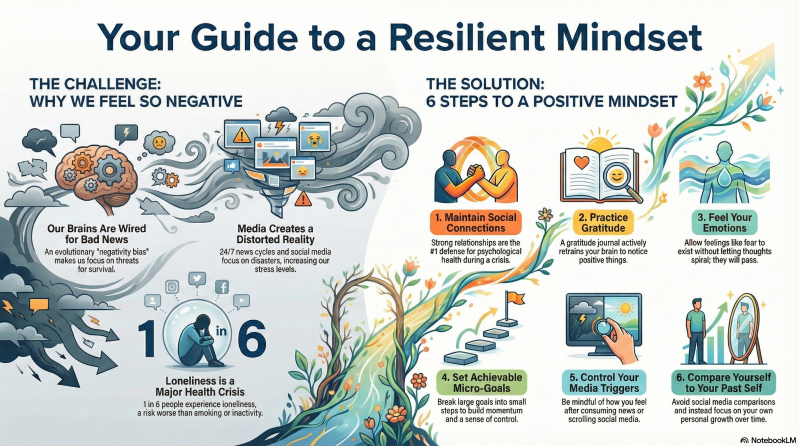
- The Negativity Bias: Our brains are hardwired from our ancestors to prioritize negative news to survive (like listening for a saber-toothed tiger).
- The Media Loop: Because of this bias, news and social media focus heavily on disasters to grab our attention.
- The Reality Check: Despite what we see online, research by Harvard Professor Steven Pinker shows that long-term data indicates the world has actually become more peaceful in many ways, with lower rates of violence and infant mortality compared to previous centuries.
2. Stay in the "Here and Now”
Dr. Mangelsdorf explains that anxiety almost always lives in the future, while grief lives in the past.
- In the present moment, most things are usually okay.
- High smartphone use often steals our attention from the present, which increases our stress levels even if our actual life circumstances haven't changed much.
3. Dr. Mangelsdorf’s 6 Tips for Mental Health
- Prioritize Social Connections Loneliness is considered the greatest health risk—statistically more dangerous than smoking, a lack of exercise, or a poor diet combined. Being connected to others provides a vital safety net during crises.
- Control Your Triggers Be intentional about when and why you use social media. After 30 minutes of scrolling, check in with yourself: Do you feel better or worse?
- Stop the Comparison Social media sets unreachable goals. Instead of comparing yourself to others, compare yourself to who you were ten years ago. Look at how you have grown and practice self-empathy.
- Practice Active Gratitude Use a gratitude journal to write down the good things in your life. This is a cognitive exercise that retrains your brain to see positive stimuli that the "negativity bias" usually ignores.
- Feel Your Feelings (Don’t Feed Them) When you feel fear or worry, try to sit with it for a moment without making the feelings bigger.
-
-
- The Short Duration of Emotion: An emotion like fear usually only lasts from a few seconds to a couple of minutes if you just breathe and feel it.
- The trouble starts when we follow "thought spirals" (e.g., "What if the climate crisis ruins everything?") which lead to paralysis and the inability to act.
-
- Set "Micro-Goals" Huge goals can feel paralyzing. Break them down into tiny, manageable steps, such as signing up for a local community event. Successfully completing a small task creates an "upward spiral" that makes you feel more capable of handling the world.
Addendum for my fellow neurodivergent peers:
Tip no. 5 - "Feel your feelings": This can be difficult for those of us with Alexithymia, which is common among neurodivergent people. We tend to feel things delayed or we can't really name them in the moment they happen. That's when delayed reflection methods like journaling can make a huge positive difference.
Tip no. 6 - "Micro-Goals": Here I recommend the book "Tiny Experiments" by Anne-Laure Le Cnuff a neurodivergent neuroscientist and psychologist
Many of these tips are normal daily business for us that we require to function, but it's still useful to be reminded of them. My favourite one is Tip no. 2 - "Trigger control". It's maybe the most important for a neurodivergent individual.
4. Building "Uncertainty Tolerance”
A major source of unhappiness is the desperate attempt to avoid things we are afraid of. Dr. Mangelsdorf suggests we need to build a tolerance for uncertainty.
- Acceptance: Instead of asking "Why me?" when things go wrong, ask "What can I concretely do now to feel better?"
- Micro-Engagement: If the world's problems feel too big, focus on your "micro-world". You might not be able to solve global politics, but you can join a local choir or help at a neighborhood school. Taking action in small ways helps you feel less like a "helpless victim."
5. Perspective: Crises as a Spark for Change
History shows that major crises often lead to necessary innovations. For example, the pandemic forced many companies to finally allow remote work, something previously thought impossible. Similarly, the plague in the 1300s eventually led to better working conditions and medical advancements.
The takeaway for the New Year: You don't have to be "happy" all the time. By focusing on your social circle, staying present, practicing patience, and taking tiny steps forward, you can remain resilient and hopeful.
—————————————————————————————————
A simple analogy for the New Year: Think of your mind like a (old school) search engine. If you only search for "disasters," that is all the algorithm will show you. By practicing gratitude and setting micro-goals, you are essentially updating your personal algorithm to make sure the "good stuff" also shows up in your results.
The below infographic was generated by the Notebook LM AI based on the original German article:
Erstelle deine eigene Website mit Webador